
Property Information Forms cover a wide range of topics, from boundaries and neighbour disputes to guarantees and services. However, one seemingly simple question on the Law Society TA6 Property Information Form is often underestimated:
“Is the property affected by Japanese Knotweed?”
For sellers, buyers and lenders alike, the answer can have significant legal and financial consequences.
What is Japanese Knotweed?
Japanese Knotweed is an invasive non-native plant species that spreads through an extensive underground root-like system. Its extensive underground rhizome system enables it to spread rapidly and regenerate from even very small fragments. One of the biggest problems with knotweed is that it may spread underground before visible growth appears above the surface. Although it dies back during the winter months, new bamboo-like stems emerge each spring and can grow to over seven feet tall by early summer with tiny creamy-white flowers appearing between August and October.
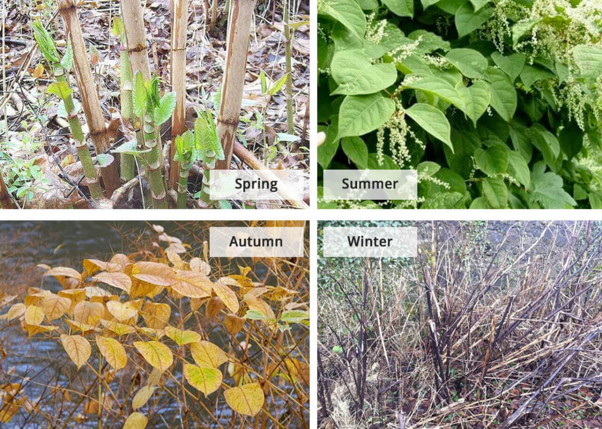
Photo from: What is Japanese Knotweed (Fallopia Japonica): Key Information
If left untreated, Japanese Knotweed can cause damage to:
- Buildings and foundations;
- Roads and drainage systems;
- Retaining walls and hard surfaces;
- Patios, driveways and boundary structures.
Its presence can significantly affect a property’s value, marketability and mortgageability, making accurate disclosure essential during a property transaction.
Japanese Knotweed and Railway Land
Japanese Knotweed is frequently found alongside railway lines, embankments and other transport corridors, which have played a major role in the plant’s spread across Britain. Railway embankments, disturbed ground and long stretches of unmanaged land provide ideal conditions for knotweed to establish and thrive. Historically, the expansion of the railway network enabled the plant to spread rapidly, with maintenance works, soil disturbance and the movement of contaminated material helping rhizome fragments travel to new locations. As a result, significant infestations developed along railway land in many parts of the UK, and knotweed remains a common sight beside tracks today. Similar patterns of spread have also been linked to road and motorway construction, where excavated soil containing hidden rhizome fragments has unintentionally introduced the plant to new areas. For homeowners living near railway land, this highlights the importance of monitoring neighbouring land and seeking professional advice if Japanese Knotweed is suspected near a property boundary.
Check the Japanese Knotweed UK Heat Map | Environet to find out whether your property may be in a higher-risk area.
Laws and Responsibilities
Japanese Knotweed is not illegal to have on your property, but you are responsible for preventing it from spreading. If it spreads onto neighbouring land, you could face civil claims for damages.
Under the Wildlife and Countryside Act 1981, it is an offence to cause Japanese Knotweed to grow in the wild, including through careless movement of contaminated soil. The Environmental Protection Act 1990 classifies Japanese Knotweed and contaminated soil as controlled waste. Japanese Knotweed and contaminated soil must generally be disposed of by licensed waste carriers at appropriately authorised facilities. Improper disposal, such as inappropriate composting, can result in enforcement action or prosecution. The Anti-social Behaviour, Crime and Policing Act 2014 allows local authorities to issue Community Protection Notices where Knotweed causes a nuisance.
How to Stay Compliant
- If you suspect that there might be Japanese Knotweed on your property obtain a professional survey from a suitably qualified specialist.
- Begin treatment as soon as possible if Knotweed is identified.
- Keep records of surveys, treatment plans, and management works.
- Use only licensed waste carriers for disposal of contaminated material.
- Monitor the site regularly and continue inspections after treatment has finished.
Professional management can reduce the risk of neighbour disputes, mortgage issues, and legal liability.
Read more about How to stop invasive non-native plants from spreading – GOV.UK.
Why Does It Matter in a Property Transaction?
Many mortgage lenders are reluctant to lend on properties affected by Japanese Knotweed unless it is being professionally managed under an appropriate treatment plan, often supported by an insurance-backed guarantee.
Treatment is rarely a quick fix. Depending on the extent of the infestation, a management programme can take several years to achieve effective control.
As a result, the discovery of Japanese Knotweed during a transaction can lead to delays, increased costs and, in some cases, the collapse of a sale.
Key Considerations
For Sellers:
- Instruct a professional survey if you suspect Japanese Knotweed may be present.
- Disclose any known infestation on the TA6 Property Information Form.
- Put an appropriate treatment or management plan in place.
- Keep records of surveys, treatment programmes, guarantees and related correspondence, and make these available to prospective buyers.
For Buyers:
- Carefully review the TA6 form and raise specific enquiries about Japanese Knotweed.
- Consider obtaining an independent Knotweed survey, particularly in higher-risk locations.
- Check the details of any existing management plan, including treatment history and guarantees.
- Factor ongoing treatment and monitoring costs into negotiations where Knotweed is present.
- Speak to your mortgage lender at an early stage to understand any lending requirements or restrictions.
For Neighbours:
- Learn how to identify Japanese Knotweed and regularly monitor your boundary areas.
- Keep photographs if you believe Knotweed is encroaching into your property.
- Raise concerns with your neighbour promptly and in writing.
- Encourage the implementation of a professional management or treatment plan.
- Avoid cutting, digging up or disposing of Knotweed yourself, as this can cause further spread.
- Seek specialist advice if the infestation is affecting the use, enjoyment or value of your property.
- Maintain clear records of any costs, damage or correspondence relating to the issue.
- Consider legal advice where a neighbour fails to take reasonable steps to control Knotweed that is encroaching into your land.
The Importance of the TA6 Property Information Form
When selling a residential property, sellers are required to complete a TA6 Property Information Form. Questions 8.6 and 8.7 specifically address Japanese Knotweed.
A seller who answers these questions inaccurately may face a claim for misrepresentation after completion.
For example:
- “No” confirms that, to the seller’s knowledge, the property is not affected by Japanese Knotweed. Sellers should exercise caution before selecting this option where no professional investigation has been carried out.
- “Not Known” should be selected where you genuinely do not know whether the property is affected and this also includes where you have not had it specifically investigated by a professional.
Providing inaccurate information, whether deliberately, or without due care can lead to lengthy and costly disputes.
Conclusion
The presence of Japanese Knotweed does not necessarily mean a property should be avoided. However, both the sellers and the buyers should fully understand the extent of the issue and the measures being taken to manage it.
Japanese Knotweed is far more than an unwelcome garden plant. It can threaten a property’s value, your investment and delay transactions if not dealt with appropriately.
If you are buying or selling a property and have concerns about Japanese Knotweed, our Residential Property team can advise on the legal implications and help keep your transaction on track.